What a life here actually looks like
This is usually the real question behind every other question. Not "what services are offered" — but "what will an ordinary Tuesday be like?"
The apartment is yours
Every home is a two-bedroom apartment with a full kitchen — a standard-size fridge, a four-burner stove and oven, a built-in dishwasher, and enough counter and cupboard space to actually cook in. A washer and dryer are in the unit, not down a corridor.
The second bedroom means the choice is genuinely yours: share with a roommate, or live alone and use it as an office. Nobody is assigned a living arrangement.
- A private bedroom with a door that closes.
- Set up for sensory needs from the start — blackout options, quiet ventilation, and lighting you control.
- A desk nook designed for focus: low-glare task light, cables managed, a wall planner if that helps.
- Smart-lock entry, so there is no key to lose.
A week might look like this
The week below is an illustration, not a resident. It is drawn from how the support model is designed to work across seven days, and it describes nobody in particular. Every real week is built with the person whose week it is.
-
Monday
Reset, and momentum on work. A gentle light alarm and a ten-minute buffer before the day starts properly. A breakfast simple enough to repeat, so the first decision of the day is not a hard one. Late morning downstairs in the coffee shop, working alongside a coach — laptop open, one job application sent, not five. Afternoon on the bike in the quiet corner of the gym. Evening: meal prep from a template, then the lights down early.
-
Tuesday
Skills, without overload. An appointment in the suite downstairs, or by tablet from the sofa — either is a real option. Then a deliberate recovery block: shower, comfortable clothes, quiet. Evening in the courtyard, twenty low-demand minutes with one person. Small on purpose. Small counts.
-
Wednesday
Out into the world. Driving off-site to an information session, an interview, a shift. A rehearsed opening line to take the edge off the first thirty seconds. Back to the coffee shop afterwards with headphones on to decompress — and, while still in work mode, one follow-up email sent before the day closes.
-
Thursday
Health and home systems. Groceries during the quiet hours, from a list that barely changes. Midday movement, then the mind-body room. Afternoon: an hour with a coach on the unglamorous things that actually hold a life together — laundry, tomorrow's clothes out, kitchen surfaces, bins. Routines, so they never become emergencies.
-
Friday
Connection. Light admin in the morning with a fifteen-minute timer and something good at the end of it. Lunch off-site with an old friend somewhere quiet and familiar. Evening out — or, if not tonight, a practice run: go to the coffee shop, start one conversation, leave on a win.
-
Saturday
Building the life you want. A community walk or a beginner class in the morning — movement and easy social exposure in the same hour. Afternoon for a hobby, deliberately protected against burnout. Evening with one or two close friends and a predictable plan.
-
Sunday
Reset and protect the week. Meal prep, and setting three non-negotiables for the week — no more than three. Then the launch pad: keys and wallet by the door, outfit ready, calendar checked, an early night to protect Monday.
The anchors that make a week work
None of the above holds together by willpower. It holds together because of a handful of small structures — and those belong to the resident, not to the staff. They travel. That is the point.
-
A sensory setup that is yours
Blackout curtains, white noise, fragrance-free products, clothing that does not scratch, predictable lighting. Not accommodations granted — equipment owned.
-
Scaffolds for the executive load
A launch checklist on the fridge. Two alarms a day — leave the apartment, start dinner. Short body-doubling sessions downstairs when starting is the hard part.
-
Boundaries that are planned in advance
Choosing quiet seating. Avoiding crowded late-night spaces. A person who is the safe contact. An exit line decided before it is needed rather than during.
Company, at a volume you choose
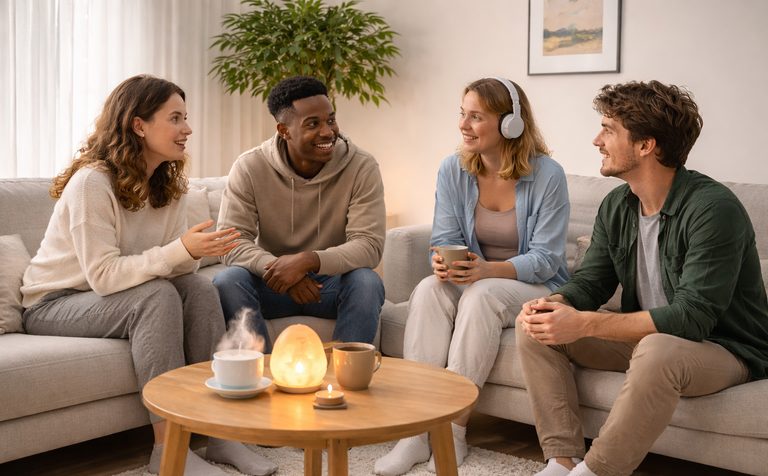
The hardest thing to design for is not activity. It is the space between people — being around others without the obligation to perform.
So there is a coffee shop where sitting alone is normal. A courtyard where twenty minutes counts as a social evening. Games rooms, a theatre, a pool with quiet hours. Monthly outings for anyone who wants them, and no register taken for anyone who does not.
Headphones on in a shared room is a perfectly good way to spend an evening here.
Work, study, and everything after
Living here is not the destination. The skills are built so they hold up anywhere — the aim is a person who could live independently somewhere else entirely, and stays because they want to.
Vocational training is optional and real: the coffee shop, the farm stand, the kitchen, store operations, business management. Job-readiness work, supported internships, and help with education plans when that is the direction.